








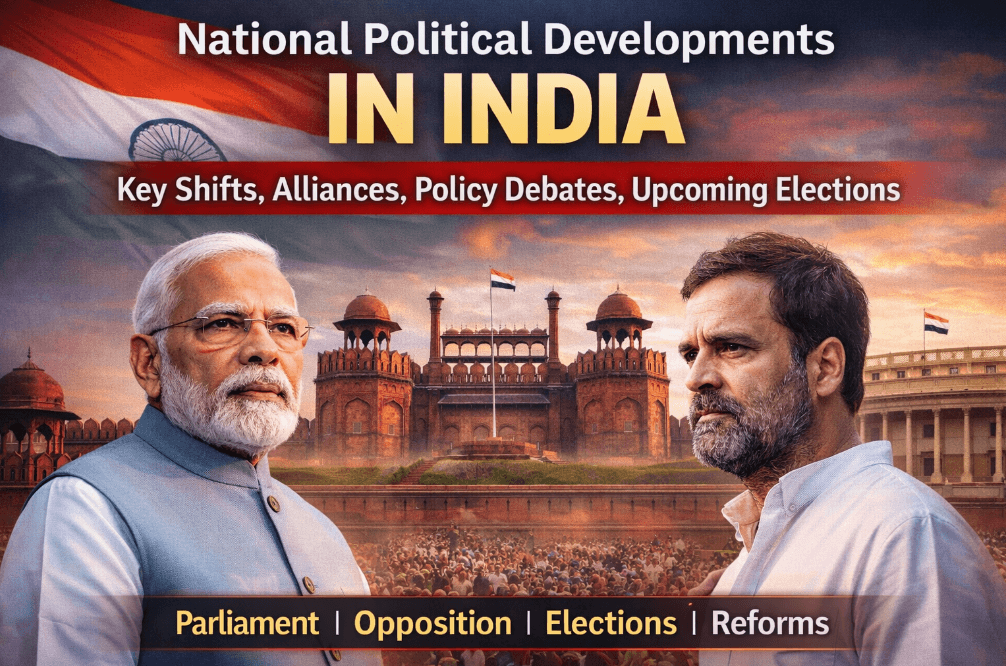
National Political Developments in India: Key Shifts, Alliances, and Policy Debates Shaping the Nation
India’s national political landscape continues to evolve rapidly, marked by intense parliamentary debates, strategic alliances, policy reforms, and preparations for upcoming electoral cycles. As the world’s largest democracy, India’s internal political shifts have implications that extend far beyond its borders, influencing global markets, diplomatic alignments, and regional stability.
The central government led by :contentReference[oaicite:0]{index=0} continues to push forward its governance agenda, while opposition leaders including :contentReference[oaicite:1]{index=1} intensify their efforts to challenge policy directions and build broader coalitions.
Parliamentary Debates and Legislative Agenda
Recent sessions of the Indian Parliament have witnessed robust discussions on economic reforms, national security measures, welfare expansion, digital governance, and federal-state relations. The ruling coalition has emphasized stability, infrastructure development, and long-term economic growth as pillars of its strategy.
Key legislative proposals include taxation reforms, updates to digital regulatory frameworks, and expansion of social welfare schemes targeting rural communities and urban poor populations. Opposition parties have raised concerns over unemployment, inflationary pressures, and institutional transparency.
Economic Policy and Reform Measures
Economic governance remains central to national political discourse. The government has highlighted infrastructure investments in highways, railways, renewable energy, and digital connectivity as engines of growth. Policymakers argue that these investments will generate employment and strengthen India’s global competitiveness.
At the same time, debates persist over fiscal deficit management, subsidy rationalization, and small-business support systems. Political discourse has focused on balancing growth ambitions with social equity commitments.
Opposition Strategy and Coalition Politics
India’s opposition landscape continues to undergo recalibration. Regional parties play an increasingly influential role in shaping national narratives. Leaders have been exploring broader alliances to consolidate votes across states.
Public rallies, grassroots campaigns, and parliamentary interventions have been central tools for opposition mobilization. The focus has largely been on issues such as cost of living, agrarian distress, youth employment, and institutional checks and balances.
Electoral Preparations and Political Messaging
With future elections always on the horizon in India’s dynamic political environment, parties are strengthening their organizational structures at booth levels. Data-driven campaigning, social media engagement, and targeted outreach strategies have become crucial components of modern political communication.
Political messaging increasingly revolves around development narratives, national pride, welfare delivery, and social justice themes. Campaign strategists are also focusing on first-time voters and urban middle-class constituencies.
Federalism and Centre-State Relations
Relations between the central government and various state administrations continue to shape national politics. Debates over fiscal allocations, resource sharing, and administrative autonomy have periodically surfaced in parliamentary and judicial forums.
State governments governed by opposition parties have sometimes clashed with central authorities over policy implementation mechanisms. Nonetheless, cooperative federalism remains a guiding principle emphasized by policymakers.
Social Policy and Welfare Expansion
Social welfare programs remain a key political instrument. Initiatives targeting housing, healthcare access, sanitation, food security, and financial inclusion have been highlighted as transformative achievements.
Critics, however, argue that implementation gaps and uneven regional impact require corrective measures. Discussions about universal basic support systems and targeted subsidies continue within policy circles.
Digital Governance and Institutional Reforms
Digital governance initiatives have expanded significantly, with emphasis on transparency, direct benefit transfers, and e-governance platforms. National debates have also touched upon data protection frameworks, cybersecurity preparedness, and digital infrastructure investments.
Institutional reforms aimed at improving judicial efficiency, administrative responsiveness, and regulatory clarity remain under discussion.
National Security and Foreign Policy Dimensions
National security remains a cornerstone of political discourse. Defense modernization, border infrastructure, and strategic partnerships form part of the government’s agenda.
India’s foreign policy engagements across the Indo-Pacific, Middle East, Europe, and North America also intersect with domestic political narratives. Trade agreements, diaspora relations, and multilateral cooperation frameworks continue to receive bipartisan attention.
Youth, Employment, and Education
Employment generation remains one of the most debated national topics. Skill development programs, startup incentives, and manufacturing incentives are central to job creation strategies.
Educational reforms emphasizing digital learning tools and curriculum modernization have also been politically significant.
Media, Public Opinion, and Political Communication
Media platforms, both traditional and digital, play a pivotal role in shaping public perception. Political discourse increasingly unfolds on social media platforms, where leaders engage directly with citizens.
Public opinion surveys suggest that governance performance, economic management, and welfare delivery remain decisive factors influencing voter sentiment.
Looking Ahead: The Future of National Politics
India’s political future will likely be shaped by economic resilience, demographic shifts, and evolving geopolitical realities. As electoral cycles continue, alliances may shift, new leadership figures may emerge, and policy priorities may adapt to changing national needs.
What remains constant is the vibrancy of India’s democratic system. Parliamentary debates, active civil society engagement, and competitive elections ensure that national political developments remain dynamic and closely watched both domestically and internationally.
As India continues its journey toward becoming a major global economic and strategic power, its internal political stability and reform trajectory will remain critical determinants of progress.


One thought on “National Political Developments in India: Key Shifts, Alliances, and Policy Debates Shaping the Future”