





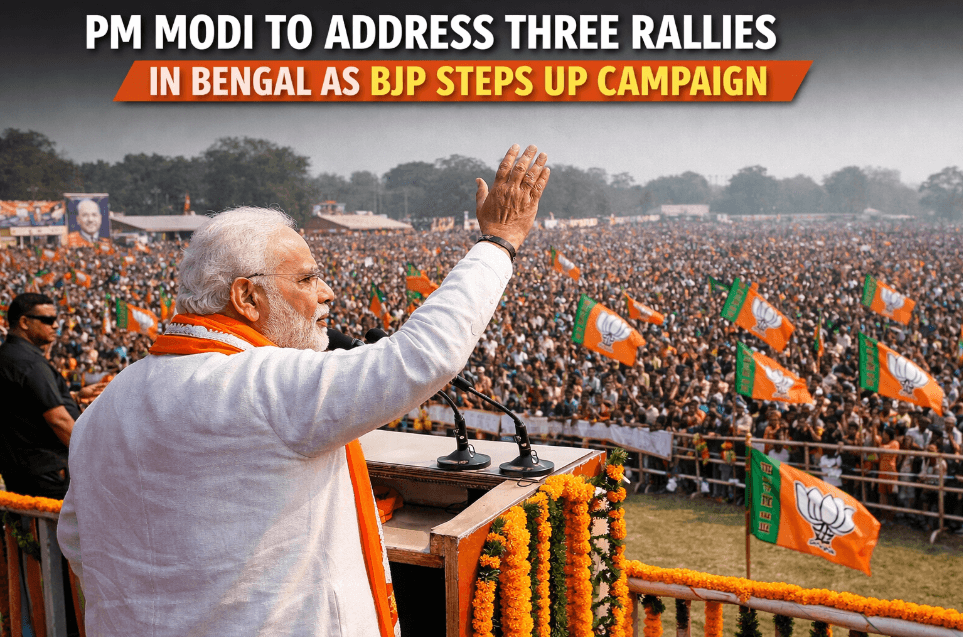
PM Modi to Address Three Rallies in Bengal as BJP Steps Up Campaign
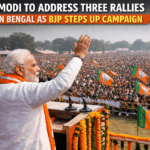
The rallies, scheduled in strategically chosen constituencies, are expected to attract massive crowds, party workers, local leaders, and undecided voters who are closely watching every move in this heated political season. Bengal has long remained a battlefield of ideology, regional identity, and national politics, and PM Modi’s presence adds a dramatic edge to the ongoing campaign.
As the BJP steps up its outreach, the message behind these rallies is clear: the party wants to connect directly with the people, highlight development achievements, and challenge the narrative built by rival parties. The speeches are expected to focus on governance, infrastructure, employment, welfare schemes, and the BJP’s long-term vision for Bengal’s future.
Why Bengal Remains a Political Power Center
West Bengal has always played a defining role in Indian politics. From historical movements to ideological revolutions, the state has influenced national conversations for decades. This makes every election campaign in Bengal far more than a regional event—it becomes a symbol of broader political momentum.
For the BJP, Bengal represents both a challenge and an opportunity. Over the last few election cycles, the party has expanded its vote share significantly, transforming itself from a marginal player into a major opposition force. PM Modi’s rallies are designed not only to consolidate existing supporters but also to appeal to first-time voters, women, youth, and rural communities.
The party’s campaign machinery has been highly active, combining digital outreach, local booth-level engagement, roadshows, and public meetings. Today’s triple-rally schedule is being projected as one of the most aggressive campaign pushes of the current phase.
The Strategy Behind Three Rallies in One Day
Conducting three rallies in a single day is not just a show of energy; it is a strategic demonstration of political intent. Each location has been selected based on caste dynamics, voter trends, regional issues, and symbolic value.
The first rally targets urban and semi-urban voters who are deeply concerned about employment, industry growth, and public infrastructure. The second rally focuses on rural communities, farmers, and welfare beneficiaries. The third aims to create momentum in a constituency where the BJP is looking to convert close margins into clear victories.
By spreading the rallies across multiple regions, the BJP ensures that PM Modi’s campaign message reaches diverse demographics in a single day, maximizing both media coverage and grassroots excitement.
Expected Key Themes in PM Modi’s Speech
Political observers expect PM Modi to focus on several major themes during the rallies. Development remains the central pillar. The Prime Minister is likely to highlight national highway expansion, railway modernization, digital transformation, direct benefit transfers, and welfare initiatives that have reached millions of households.
Another major theme is likely to be women empowerment. BJP leaders have increasingly emphasized schemes related to housing, cooking gas, sanitation, healthcare, and financial inclusion, all of which resonate strongly with women voters.
Youth employment and entrepreneurship could also dominate the speech, especially given Bengal’s large student and young workforce population. Startups, skill development, and technology-based opportunities are expected to be presented as the BJP’s roadmap for the state.
Ground Reactions and Public Excitement
On the ground, BJP workers are treating the rallies like a festival of political energy. Large banners, lotus flags, LED screens, volunteer camps, and transportation arrangements are visible across the rally zones. Social media teams are simultaneously amplifying visuals, slogans, and live moments from the event.
Local citizens, meanwhile, are expected to attend in huge numbers, driven by curiosity, political interest, and the magnetism associated with a Prime Ministerial rally. Whether they support the BJP or not, PM Modi’s speeches often become headline events that influence the wider news cycle.
The atmosphere surrounding the rallies is likely to shape not just immediate media narratives but also the morale of party cadres working at the booth level.
Impact on Bengal’s Election Narrative
These rallies could significantly impact the state’s election narrative. In modern campaigns, perception often moves faster than policy, and high-energy rallies help create the image of momentum. A strong turnout can influence undecided voters by projecting confidence and inevitability.
The BJP’s aim is to convert PM Modi’s national popularity into localized voter trust. If the speeches successfully connect national achievements with Bengal-specific aspirations, the party could gain an important psychological edge over its rivals.
Political analysts will closely watch crowd response, speech themes, and regional reactions to assess whether this rally push changes the mood of the electorate.
Conclusion
PM Modi’s three rallies in Bengal are more than campaign events—they are a carefully designed political statement. They reflect the BJP’s seriousness, organizational depth, and desire to position Bengal at the center of its future strategy.
As the campaign intensifies, these rallies may become one of the defining moments of the election season. Whether they translate into votes will be decided later, but for now, they have already succeeded in capturing public attention, media focus, and political conversation across the state.
Bengal watches, the nation observes, and the political temperature continues to rise.