







Indian Economy 2026: Growth Engine of the Global South and the Road to a $5 Trillion Future
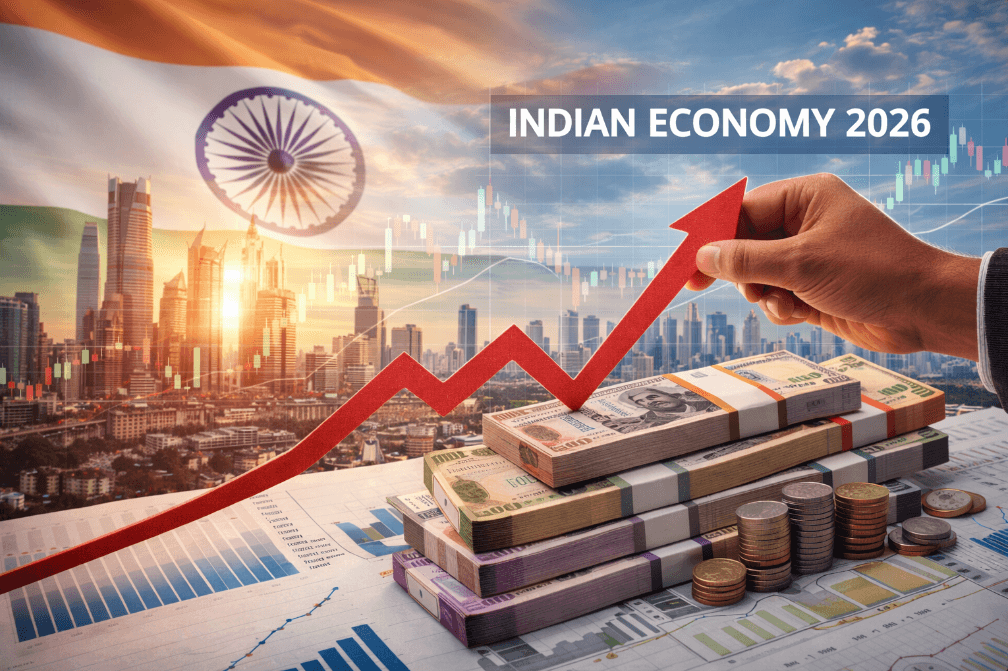
The Indian economy stands at a defining moment in 2026. As one of the fastest-growing major economies in the world, India has positioned itself as a central pillar of global growth. Amid geopolitical shifts, supply chain realignments, and digital transformation, India is emerging not only as a consumption powerhouse but also as a manufacturing and innovation hub.
With consistent GDP expansion, a thriving startup ecosystem, infrastructure modernization, and strong domestic demand, the country is steadily moving toward its long-term ambition of becoming a $5 trillion economy.
India’s GDP Growth Momentum
India has maintained strong GDP growth compared to many advanced economies. Driven by domestic consumption, government capital expenditure, and expanding exports, growth projections remain robust.
- Strong private consumption demand
- Rising government infrastructure spending
- Resilient services sector
- Expanding digital economy
The services sector continues to dominate, contributing more than 50% to GDP, while manufacturing and agriculture remain critical pillars supporting employment and exports.
Manufacturing and “Make in India” Push
India’s manufacturing revival has gained momentum through initiatives such as Production Linked Incentive (PLI) schemes and “Make in India 2.0.” Key sectors witnessing growth include:
- Electronics manufacturing
- Semiconductor assembly
- Automobile and EV production
- Defense manufacturing
- Pharmaceutical exports
Global companies diversifying supply chains are increasingly viewing India as a viable alternative production base. The expansion of industrial corridors and logistics infrastructure further strengthens this transition.
Digital Economy Transformation
India’s digital public infrastructure has become a global case study. Platforms such as UPI, Aadhaar, and Digital India initiatives have transformed payments, identity verification, and public service delivery.
The digital economy now contributes significantly to GDP through:
- Fintech growth
- E-commerce expansion
- AI and SaaS startups
- Online education platforms
- Gig economy services
India is also witnessing rapid adoption of AI, cloud computing, and blockchain technologies across sectors.
Infrastructure Boom
Massive government investments in highways, railways, airports, and renewable energy projects are reshaping the economic landscape. The National Infrastructure Pipeline and Gati Shakti master plan aim to integrate transport and logistics networks.
Improved connectivity enhances trade efficiency and reduces operational costs, encouraging both domestic and foreign investment.
Foreign Direct Investment (FDI)
India continues to attract strong foreign direct investment inflows, especially in technology, renewable energy, manufacturing, and fintech. Policy reforms, simplified tax structures, and digital compliance frameworks have enhanced ease of doing business.
Strategic partnerships with global economies further strengthen capital inflows and technology transfer.
Stock Market Performance
The Indian stock market remains one of the most dynamic in Asia. Benchmark indices have seen steady long-term growth supported by corporate earnings expansion and rising retail participation.
Demat account openings continue to increase as financial literacy improves and middle-class participation in equity markets grows.
Inflation and RBI Monetary Policy
Inflation management remains a critical priority. The Reserve Bank of India (RBI) balances growth support with price stability through calibrated monetary policies.
Key focus areas include:
- Maintaining inflation within target bands
- Supporting liquidity
- Ensuring banking system stability
- Monitoring global commodity price fluctuations
Banking and Financial Sector Stability
India’s banking sector has strengthened with improved asset quality, reduced non-performing assets, and digital transformation in lending practices. Fintech partnerships are enhancing credit accessibility for MSMEs and rural entrepreneurs.
MSME and Startup Ecosystem
Micro, Small, and Medium Enterprises (MSMEs) form the backbone of employment generation. Government-backed credit guarantee schemes and digital marketplaces have improved access to capital and markets.
India also ranks among the top startup ecosystems globally, particularly in fintech, edtech, healthtech, and SaaS domains.
Exports and Trade Performance
India’s exports have diversified beyond traditional goods. Key growth areas include:
- IT services exports
- Pharmaceuticals
- Engineering goods
- Textiles
- Renewable energy equipment
Trade agreements with global partners aim to expand market access and reduce tariff barriers.
Renewable Energy and Green Economy
India is investing heavily in renewable energy, targeting large-scale solar and wind power expansion. The green hydrogen mission positions India as a future clean energy exporter.
Sustainable finance instruments and ESG investments are gaining traction in domestic markets.
Challenges Facing the Indian Economy
Despite strong growth prospects, challenges remain:
- Global economic uncertainty
- Commodity price volatility
- Unemployment among youth
- Income inequality
- Rural-urban development gaps
Structural reforms and skill development programs are essential to address these issues.
Demographic Dividend Advantage
India’s young population presents a significant opportunity. With a median age below many developed nations, workforce expansion can drive productivity if supported by education and skill development initiatives.
Rural Economy and Agriculture
Agriculture remains crucial, supporting millions of livelihoods. Digital agri-tech solutions, crop insurance programs, and improved supply chains are modernizing the sector.
Urbanization and Real Estate Growth
Rapid urbanization fuels demand in housing, infrastructure, and smart city projects. Real estate markets in major metropolitan cities show renewed momentum.
Future Outlook: Road to $5 Trillion Economy
India’s ambition to reach a $5 trillion economy is supported by:
- Infrastructure expansion
- Manufacturing scale-up
- Digital economy leadership
- Startup innovation
- Global trade integration
If sustained reforms continue and global conditions remain stable, India is well-positioned to become a major economic superpower in the coming decade.
Conclusion
The Indian economy in 2026 represents resilience, opportunity, and transformation. From digital breakthroughs to manufacturing expansion and green energy leadership, India is reshaping its economic identity.
As global power dynamics shift, India stands not just as a participant — but as a driving force in the future of the world economy.